


Creation date: 29.10.2025 13:07:56
Date modified: 06.11.2025 14:39:52
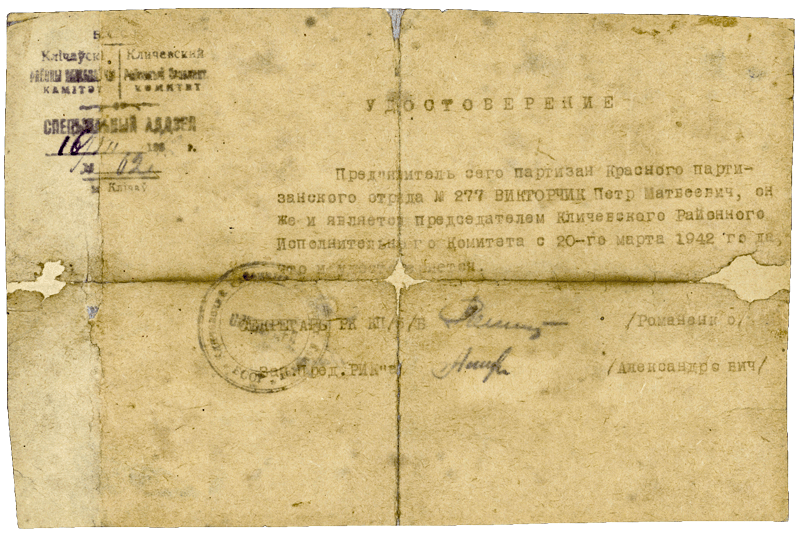
Certificate of P.M.Viktorchyk, the partisan of the 277th Detachment and leader of the Klichaw Rajon Executive Committee in the Klichaw Partisan Zone, 1942.
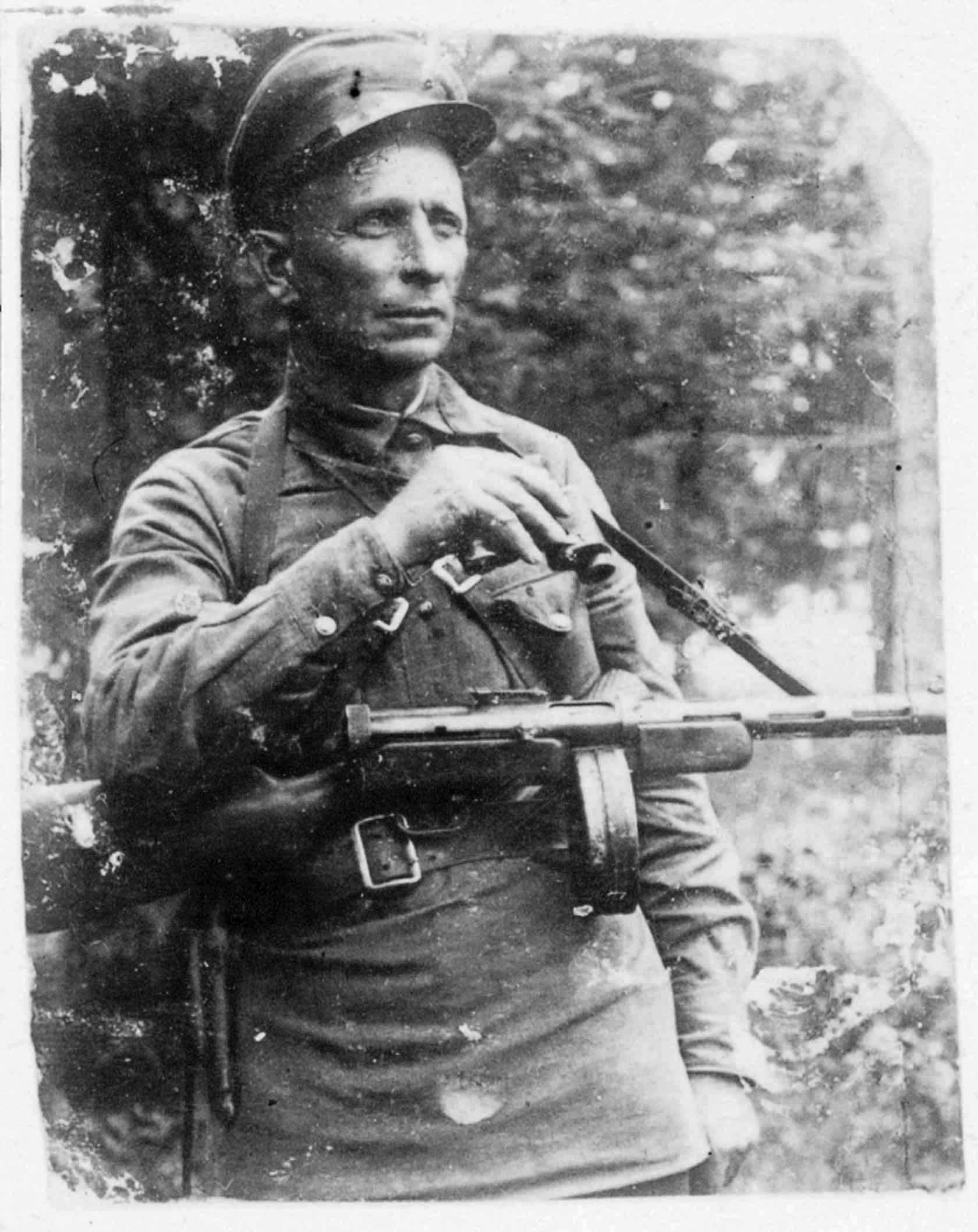
P.M.Viktorchyk, the leader of the Klichaw Rajon Executive Committee in the Klichaw Partisan Zone, 1942.
ˈKlichaw ˈPartiˈsan ˈZone
Partisan-controlled territory of Klichaw, partially adjacent to it Asipovichy, Bialynichy, Bierazino, Kirawsk, and other rajons of Magiliow Voblasc.
October 1941 witnessed the beginning of the zone’s formation in the course of partisan battles for the liberation of Klichaw Rajon from German Nazi invaders. In October 1941 — March 1942, partisan detachments defeated more than 80 enemy garrisons and police stations in the territory of Klichaw (including on March 20, 1942, in Klichaw town) and its adjacent rajons (see Klichaw battles of 1942, 1943). On April 3, 1942, at the meeting of rajon communists in Usakina village, a resolution on the restoration of the Soviet regime in Klichaw Rajon was adopted. The Klichaw Rajon Committee of the Communist Party (Bolsheviks) of Belarus, Klichaw Rajon Executive Committee, and the Klichaw Operation Centre were formed. At the end of 1942, the liberated territory was about 1.9 thousand km²; it was held by the 208th, 277th, 752nd, 61st, 128th, 760th, 620th detachments. At the beginning of 1944, there were more than 70 thousand civilians in the zone whose territory exceeded 3 thousand km²; more than 18,000 partisans defended it.
In August—October 1942, the Babrujsk Underground Interrajon Commitee of the Communist Party (Bolsheviks) of Belarus, from April 1943, the Magiliow Underground Voblasc Commitee of the Communist Party (Bolsheviks) of Belarus with the headquarters of the Magiliow (voblasc) MOG under it, and Bialynichy, Bierazino, Magiliow, and other underground rajon committees of the communist Party (Bolsheviks) of Belarus and the Leninist Young Communist League of Belarus were based in the territory of this zone. Underground newspapers such as the voblasc Za Radzimu («За Радзіму»; lit. ‘for the Motherland’), the rajon Golas Partyzana («Голас партызана», lit. ‘the partisan’s voice’), etc. were published. From June 1942, radio communication was maintained, from July, air communication with the Big Land was established; partisan airfields operated in Klichaw town and Galynka village of Bierazino Rajon.
The defence of the Klichaw Partisan Zone was provided by the commands of the Klichaw Partisan Formation (April 3, 1942 — April 6, 1943) and the Magiliow Military Operation Group led by the Magiliow Underground Voblasc Commitee of the Communist Party (Bolsheviks) of Belarus (April 6, 1943 — April 28, 1944) along the defensive lines that ran along the rivers Druc, Olsa, Susha, Biarezina, and Niasieta. For more than 2 years, partisan detachments, regiments and brigades, self-defence detachments fought against much larger enemy forces besieged by more than 20 German garrisons formed by the 203rd and 286th Security divisions and police battalions along highways and on separate sections of the Magiliow — Asipovichy railway; they resisted during the punitive operations Chaffer, Eagle, Ivanov, № 5, № 11, and others; they inflicted significant manpower losses on the enemy. In the battles on the Olsa, in the forest of Usakina, from June 30 to August 9, 1942, partisans defeated the Hitlerite Battalion Biarezina, destroyed a part of the Special SS Battalion under O. Dirlewanger and 608th Security Regiment, exploded an armoured vehicle with the regiment commander who controlled the punitive group; only from July 1 to July 4, 1942, in the battles for the villages of Vialikaja Staryna and Stary Spor, they completely destroyed 2 enemy companies (more than 200 soldiers and officers). In May 1943, at the borders of the Usakina Forest, the people’s avengers destroyed about 400 Hitlerites, but lost 199 of their comrades killed. In battles with the enemy, in protection of the zone and its inhabitants, the partisans exercised courage, heroism, and self-sacrifice, i.e. during the Kuchynsk battle of 1942, 15 combat soldiers of the 61st Partisan Detachment fought to the last ditch, blew themselves up with the enemies, using grenades. Almost constant connection with the Big Land, protection of the population from the punitive forces, successful combat activity within the enemy’s communications, against its garrisons, and other objects were provided for the partisans by the persistent defence of the zone.
In June 1944, the zone partisan formations joined the Red Army.
In Klichaw, in honour of the partisans who liberated the village in March 1942, the Immortality Kurgan (barrow) was raised and a monument was placed;
A monument was raised at the landing place of the first plane from the Big Land.
Беларусь у Вялікай Айчыннай вайне, 1941–1945: энцыклапедыя / Рэдкал.: І. П. Шамякін (гал. рэд.) [і інш.]. – Мінск: Беларуская Савецкая Энцыклапедыя імя Петруся Броўкі, 1990.
Партизанские формирования Белоруссии в годы Великой Отечественной войны (июнь 1941 — июль 1944) / А. Л. Манаенков (руководитель) [и др.]. – Минск: Беларусь, 1983.
